Concept

The open-loop dashboard, and what makes one actionable

A concept, not a delivered project: most business reports are open loops that end at a person's attention. The fix is not a better chart. It is a named owner, a numeric threshold, and an action agreed before the number moves.

Field: reporting and decisions, small business · Location: Sweden and UAE · Type: closed-loop reporting · Status: concept

Still life on dark slate: one copper ring standing open with a gap cut through it, and a second copper ring closed, held to a rusted rod by a brass clasp with a small clay sphere resting at its rim
01

Monday morning, the report arrives and nothing changes

The report lands at 08:40 on Monday. Revenue by channel, stock on hand, hours logged, three charts that took someone most of Friday. Everyone opens it. Two people say the numbers look about right. By Tuesday nobody has opened it again, and nothing that week is different because the report existed.

An open-loop dashboard is a report that ends at a person's eyes. A dashboard is actionable only when three things hang off a number: a named owner who watches it, a numeric threshold that says when the number is speaking, and a pre-agreed action for when it crosses. Everything else is decoration.

Benn Stancil, co-founder of Mode Analytics and now Field CTO at ThoughtSpot, named the mechanism on ThoughtSpot's podcast The Data and AI Chief in October 2023: "Courage, ultimately, is needed in making a decision that you have to own. [Unfortunately], data can be a punt. If you make a data driven decision, nobody made the decision. The data made the decision. There is like an abstraction there of who was actually responsible for it." (Episode 81.)

The episode is from 2023 and the sentence has not aged a day. That abstraction is what an open loop manufactures: a number arrives, a room finds it interesting, and the next step belongs to nobody.

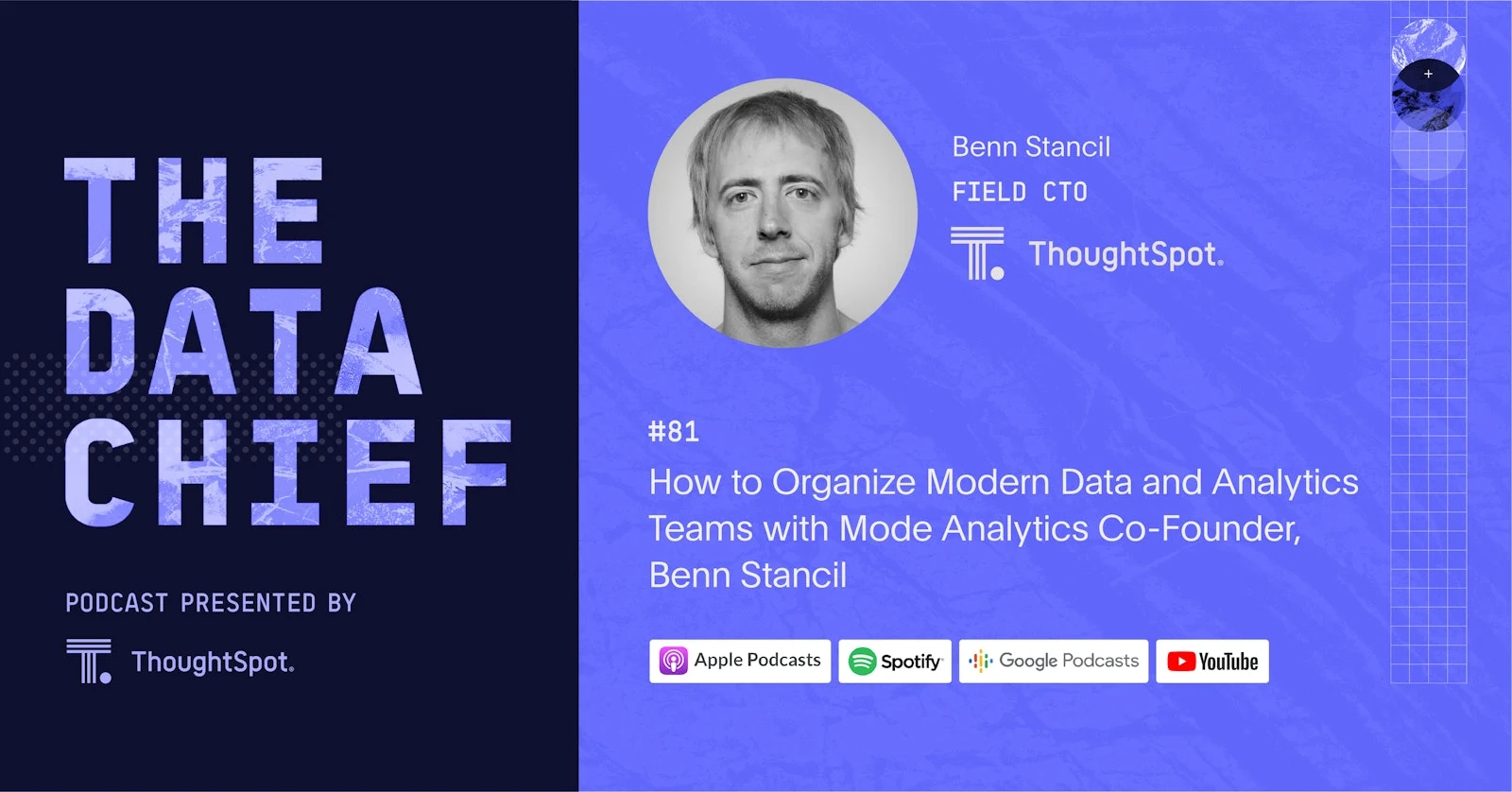
How to Organize Modern Data and Analytics Teams with Mode Analytics Co-Founder, Benn Stancil

The Data and AI Chief, episode 81, October 2023 · 60 minutes

Nothing loads from Spotify until you press play.

02

Dashboard vs report: the comparison that misses the point

Ask which is better, a dashboard or a report, and the answer is usually about refresh rates: a report is a snapshot, a dashboard is live. That changes nothing on Monday morning. The distinction that does is open loop against closed loop: one terminates at somebody's attention, the other ends in an action.

The cost of the open kind shows up as indifference. BARC and Eckerson Group surveyed 214 data and analytics leaders and reported in March 2022 that active BI and analytics usage averaged 25 percent of employees, a number stuck around 20 percent for years.

The executives who bought the tools say much the same about themselves. In NewVantage Partners' 2022 survey of Fortune 1000 data and AI leaders, 26.5 percent said they had created a data-driven organisation, while 91.9 percent named culture rather than technology as the main barrier, for the fourth year running.

None of that argues against deciding with data. Firms that adopted data-driven decision-making showed output and productivity 5 to 6 percent higher than otherwise expected (Brynjolfsson, Hitt and Kim, ICIS 2011). The dashboard is simply a weak vehicle for it. Will Perkins, Analytics Solutions Executive at JPMorgan Chase, put it on The Data Nerd Podcast in April 2026: "Dashboards aren't dead. But a lot of what we've been building probably should be."

03

Three things that turn a report into an actionable dashboard

01

A named owner, not a distribution list

One person's name written against the number, and only one. Not the team, not the Monday meeting. A number everybody watches is a number nobody watches, and a distribution list builds Stancil's abstraction on purpose: the data decided, so no one did.

02

A numeric threshold that says when the number is speaking

Not "stock is getting low" but "fewer than 12 units on any of the top 30 lines". Not "replies are slipping" but "more than four hours to a first reply". The threshold is the only condition under which the report may interrupt someone. Below it, the number stays quiet by design.

03

A pre-agreed action, decided before the number moves

Agreed on a calm afternoon rather than mid-crisis: at 12 units a reorder is drafted against the usual supplier and put in front of the owner for one decision, as a short message in the channel the business already uses. Deciding the response in advance is what turns a chart into a loop. Improvising it is what turned the last dashboard into wallpaper.

Also in the box one loop is a real deliverable. The first engagement wires exactly one number to exactly one action and runs it for a month, and the honest test at the end is whether anyone would notice if it stopped. A free scoping call, then a fixed price for every step. You always know the cost before you commit.

04

The threshold is a judgment call, and it stays with a person

The mechanism hides a human decision inside a number, and pretending otherwise is how these systems lose trust. Somebody has to decide the line is 12 units and not 8, and that comes from knowing which supplier goes slow in July. A system can propose a threshold. It cannot know what the business is about to try.

So the action is drafted and never dispatched. Anything that reaches a customer, a supplier or an employee's pay stops at a named person's approval. The loop closes on the decision, not on the consequence.

Thresholds are reviewed on a rhythm, because a line set in January and never argued with again is how a closed loop quietly reopens. That is also the answer to Stancil's abstraction, and it is not a technical one: a named owner with a pre-agreed action still owns the decision.

05

What changes, and what a closed loop does not fix

What changes is small and easy to check. One number now has an owner, a line and a next step, and the report stops being a weekly ceremony. Most weeks it says nothing at all, which is the point: an actionable dashboard that is silent for three weeks is working, not broken.

The failure mode is the mirror image of the one it replaces. A threshold set too low turns a loop into noise, and noise gets ignored on the same schedule dashboards do. In IDC research for Critical Start reported by Forbes in November 2021, organisations ignored between 23 and 30 percent of their security alerts depending on size. Different domain, same arithmetic.

A closed loop cannot rescue a number that is wrong either. Wire an action to a stock figure three days stale and the result is an automated mistake arriving faster than the manual one did. So this work often starts one page over, with what the records actually say and whether the shelf agrees with the system.

07

Start with one number, not with a reporting project

A reporting project produces a dashboard. A decision loop produces a different Tuesday. The place to start is not the report everyone agrees is useful, it is the one number that quietly cost the business money twice this year. Name its owner, set its line, and agree now what happens when it crosses.

Book a free scoping call